
Fort Valley is the Peach County seat and home to Fort Valley State University, and that combination produces two distinct streams of mold work: older owner-occupied housing, and student and faculty rental property that turns over on an academic calendar.
The rental side has a pattern we see repeatedly in university towns. Units sit closed and unconditioned through the summer break with the power down or the thermostat off to save money, and in central Georgia that is the worst possible treatment for a house. Interior humidity climbs unchecked for weeks, and growth establishes on closet walls, on bathroom ceilings, behind furniture against exterior walls, and on anything soft left in the property. The calls arrive in August when students return, and by then it is a remediation rather than a wipe-down. If you manage rentals here, running the air at 78 through the break costs a fraction of what the remediation does.
The older owner-occupied housing follows the regional pattern: open crawl spaces over bare clay with no vapor barrier, plaster over lath in the oldest properties, and air conditioning retrofitted through unconditioned attics. Ground moisture rising through the floor is the leading cause, with duct condensation second. Peach County's clay drains slowly, so storm water sits against foundations for days rather than draining away, and a sealed crawl space liner is usually the highest-value item on the quote.
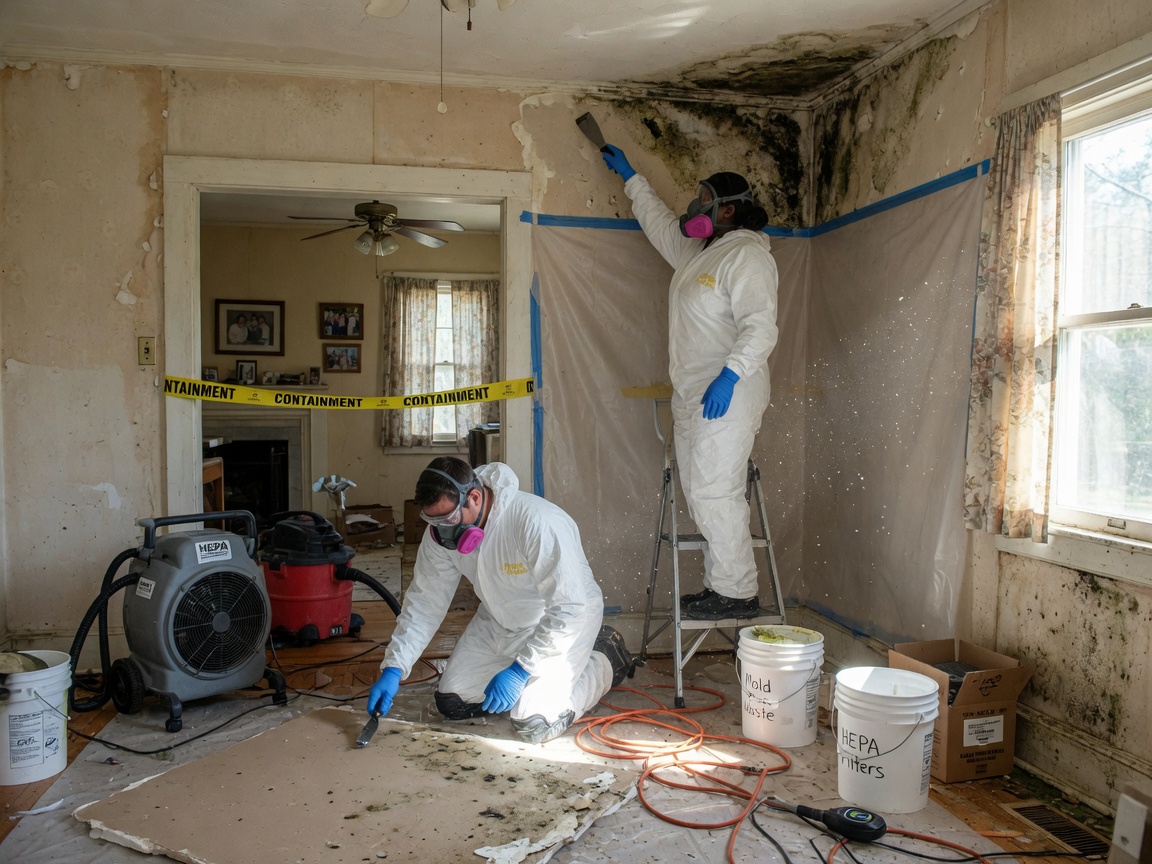
Older rental stock adds a complication worth raising. A good proportion of it predates 1978, which means painted surfaces should be assumed to contain lead until tested. Disturbing them during mold demolition releases lead dust, and that is a more serious health risk than most mold findings where young children are in the property. It requires lead-safe work practices, and a contractor who does not mention it on a house of that age is not paying attention.
For landlords we produce the documentation a lease dispute or a turnover actually needs: written scope, moisture readings recorded by location, photographs, and independent clearance testing with the lab report. Georgia has no mold-specific statute, so responsibility comes down to the lease and to whether the cause was a maintenance failure or tenant conduct — and the documented moisture source is what both sides end up relying on.
For landlords the useful sequence is mold inspection and testing between leases, then mold and mildew removal or black mold removal, with post remediation clearance testing for the lease file. Owner-occupied housing usually needs crawl space encapsulation and attic mold removal. Pre-1978 properties should read the lead-safe section of historic home mold remediation. Campus and commercial buildings: commercial mold remediation. All services; nearby Byron, Perry and Peach County.
Around Fort Valley
We regularly work near:
- 📍Fort Valley State University
- 📍Camellia Boulevard
- 📍Peach County Courthouse
- 📍Main Street
- 📍Vineville Street
- 📍Highway 341
Mold Remediation in Fort Valley — Local Notes
- •University rentals left closed and unconditioned over summer break are the most common source of mold calls here.
- •Older owner-occupied housing has bare clay crawl spaces with no vapor barrier and retrofitted attic ductwork.
- •Peach County clay drains slowly, holding storm water against foundations for days after rainfall.
- •Much of the older rental stock predates 1978, so painted surfaces require lead-safe handling during demolition.
- •Landlord and tenant disputes turn on the documented moisture source, which we record in writing as standard.