
Most whole-house mold problems in Macon start underneath the house. A large share of homes here sit on an open crawl space over bare Georgia clay, and that soil gives off moisture continuously. Warm air rising through the floor pulls it up into the living space, which is why the complaint usually arrives as a musty smell in a closet or a back bedroom rather than as visible growth anyone can point at. Clean the bedroom and nothing changes. The colony is on a floor joist below it.
Two conditions make it worse here than in drier parts of the country. Clay holds water against the foundation long after a storm, so the ground under the house stays damp for days. And Macon's mild winters never give the space a hard freeze-dry, so there is no natural reset — moisture control has to be active in January as much as in July. Houses built before about 1960 commonly have no vapor barrier at all, dirt floors, and vent openings sized by a code that assumed outside air would dry the space. In a humid climate, open vents often do the opposite: summer air carries more moisture in than it removes, and it condenses on cool ducts and joists.
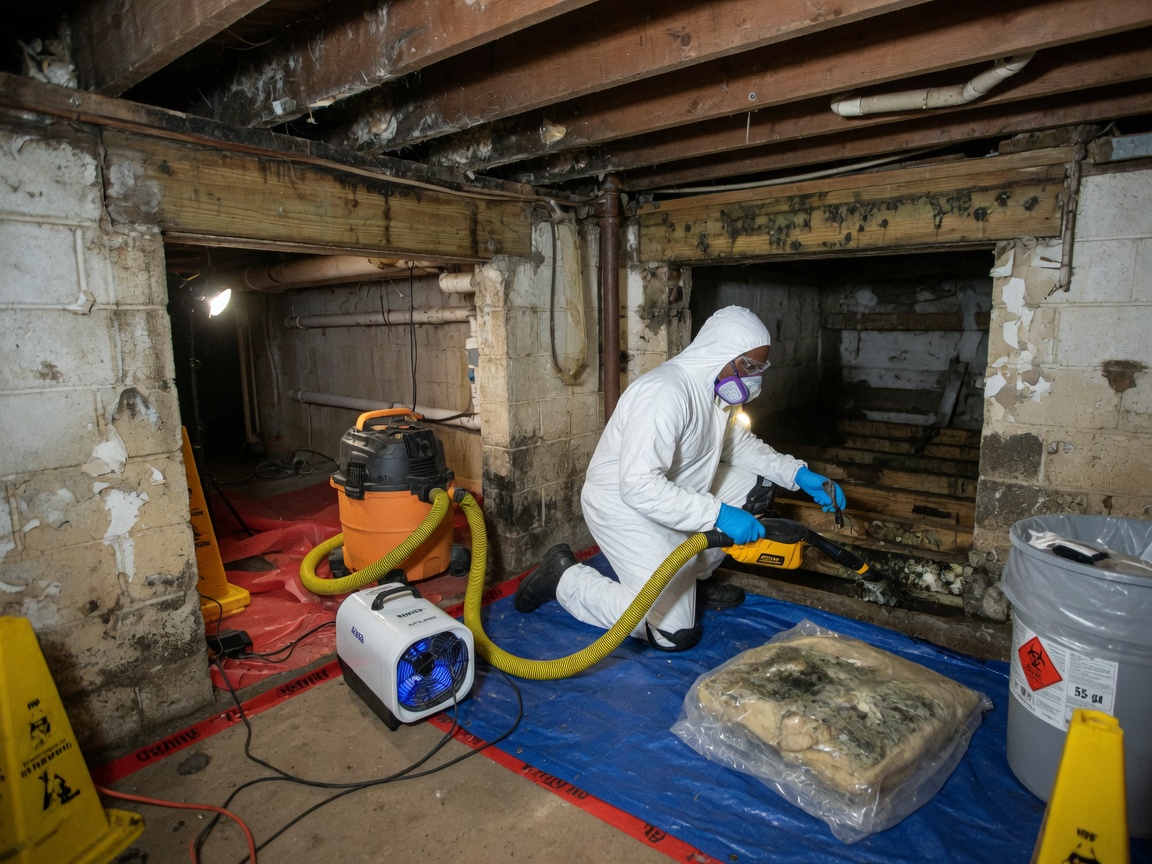
Remediation runs in a fixed order, and the order is the part that matters. The space is contained with poly and put under negative air with HEPA filtration before anything is disturbed, so spores do not get pulled up into the house during the work. Wet or contaminated insulation comes down and is bagged. Joists, subfloor, and masonry are HEPA vacuumed, scrubbed where there is surface growth, and treated with an EPA-registered antimicrobial. Then the space is dried with commercial dehumidification until wood moisture content holds below 12 percent, verified by meter and documented by location.
Only then does the permanent work happen. A sealed liner over the floor and up the walls blocks ground moisture, which is the single highest-value item on most of these jobs. Where water is entering rather than evaporating, the fix is outside: regrading so the ground falls away from the foundation, extending downspouts clear of the wall, or an interior perimeter drain where the water table is genuinely high. A dedicated crawl space dehumidifier holds relative humidity at or below 50 percent afterward. We quote encapsulation and drainage as line items you can see, because sealing a space that is still taking on water just traps it.
One honest caution on scope. If your crawl space has standing water, sagging insulation across most of the floor, and soft subflooring, the mold is a symptom of a water management problem that costs more than remediation to solve properly, and a cleaning-plus-barrier job will fail inside a year. We will tell you that at the inspection rather than after the invoice. Conversely, a small patch of surface growth on one joist with a clear cause — a dripping fitting, a disconnected dryer vent — is a contained, affordable job, and we will say that too.
Technician insight
The counterintuitive one in Macon is crawl space vents. Homeowners open them in summer believing airflow dries the space, and it does the opposite — humid 90-degree outside air hits joists and ducts that are cooler than the dew point, and it condenses there. We have seen crawl spaces measurably wetter with the vents open than closed. In this climate, the reliable approach is sealing the ground, closing the space to outside air, and controlling it with a dedicated dehumidifier. If a contractor tells you more ventilation is the answer here, they are applying a northern rule to a Georgia house.
Musty Back Bedroom, Dry Walls
A 1950s home had a persistent musty odor in one back bedroom, worst after spring rains, with no visible growth and normal moisture readings on every wall and ceiling in the room. The crawl space below was the source: bare clay floor with no barrier, sagging wet insulation across roughly a third of the span, and surface growth along four joists. A downspout was also discharging directly against that corner of the foundation. We contained and dried the space, removed the wet insulation and treated the joists, installed a sealed barrier, and extended the downspout eight feet out. The bedroom odor was gone within a week of drying and the space held below 50 percent humidity through the following summer. No drywall in the bedroom was ever opened.
Basement and Crawl Space Mold Remediation Services We Offer
✓Crawl Space Mold Removal
Removal from joists, subfloor, and insulation under containment, with spores kept from migrating up into the living space during the work.
✓Basement Wall Treatment
HEPA cleaning and EPA-registered antimicrobial on concrete and masonry, applied only after the water entry point has been identified and corrected.
✓Vapor Barrier Installation
Sealed liner over the floor and up the walls to block ground moisture from bare clay — usually the highest-value item on a Macon crawl space job.
✓Insulation Replacement
Removal of wet or contaminated batts and installation of material rated for sustained high humidity rather than a like-for-like replacement that fails again.
✓Dehumidifier Placement
A dedicated crawl space unit sized to the volume, set to hold relative humidity at or below 50 percent year-round, including through mild winters.
✓Drainage and Grading Correction
Regrading, downspout extensions, or an interior perimeter drain where water is actively entering rather than simply evaporating off the soil.
Basement and Crawl Space Mold Remediation Cost in Macon, GA
| Service | Typical Range | What Affects It |
|---|---|---|
| Small Crawl Space Spot Treatment | $450–$900 | Under 100 sq ft with accessible entry and a single identified cause |
| Full Crawl Space Remediation | $1,400–$3,200 | Whole-space cleaning, insulation removal, drying, and sealed vapor barrier |
| Basement Wall and Floor Job | $1,800–$4,500 | Includes insulation removal and wall treatment; excludes structural repair |
| Dehumidifier Supply and Install | $850–$1,600 | Dedicated unit sized to the space volume, set for year-round operation |
| Grading or Drainage Correction | Quoted separately | Scope depends on the water source; priced after the exterior assessment |
Ranges are typical for Macon, GA and confirmed with an exact written quote before any work starts.
How it works
- 1
Assessment and Water Diagnosis
Meter and borescope survey of the space, plus an exterior walk of grading and downspouts, to separate ground evaporation from active water entry — the two need different fixes.
- 2
Containment Setup
Poly barriers and negative air with HEPA filtration isolate the space before materials are disturbed, which matters most in homes where the crawl space shares air with the HVAC.
- 3
Removal and Cleaning
Contaminated insulation is removed and bagged; joists, subfloor, and masonry are HEPA vacuumed, scrubbed, and treated before any drying equipment is placed.
- 4
Drying to Verified Target
Commercial dehumidification runs until wood moisture content holds below 12 percent, confirmed by meter and recorded by location rather than by feel.
- 5
Encapsulation and Moisture Control
Sealed vapor barrier, any required grading or drainage work, and a correctly sized dehumidifier — quoted as separate line items so you can see what you are paying for.
Pricing
Small isolated growth with a clear cause runs a few hundred dollars. A full crawl space with encapsulation runs into the low thousands, and jobs needing drainage or subfloor repair go higher. Remediation, vapor barrier, and drainage are quoted separately so you can stage the work rather than commit to all of it at once.