
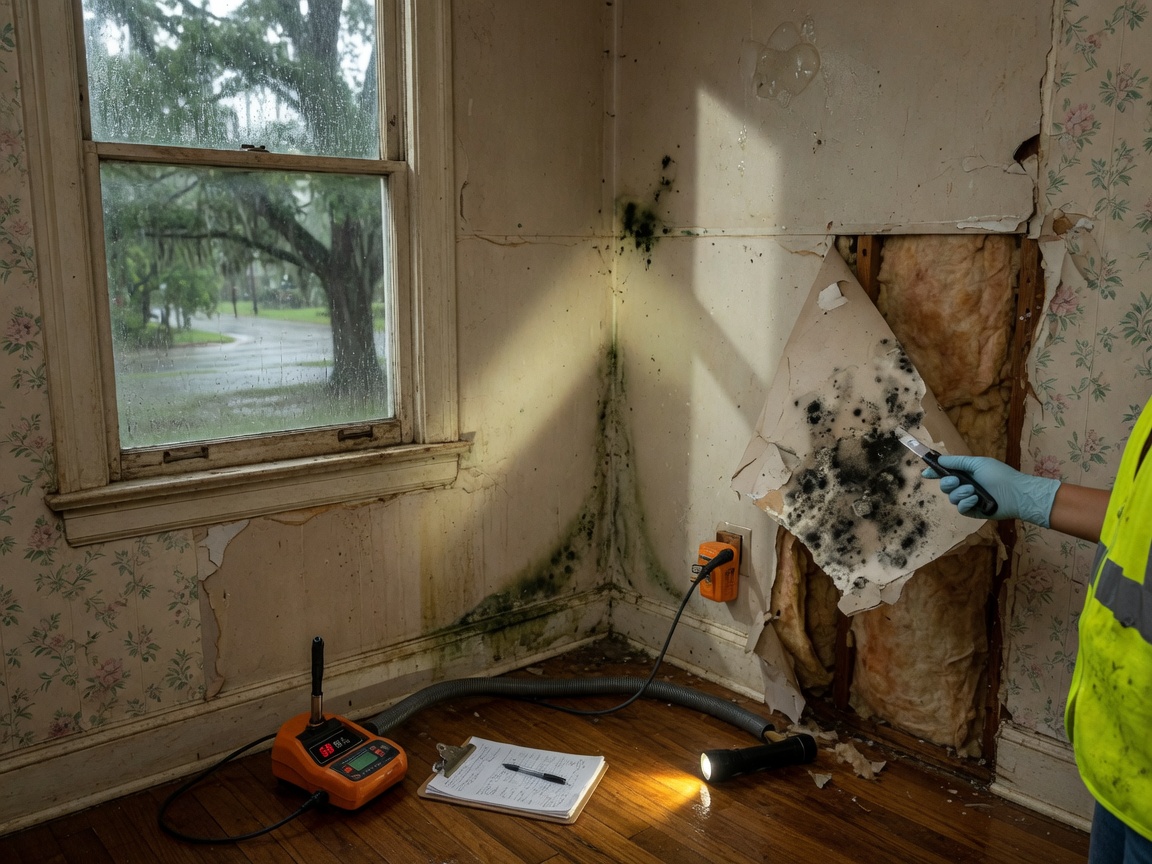
Ingleside is a planned neighborhood developed from 1917 onward, laid out across roughly 500 acres on a plateau about three miles northwest of downtown Macon, and listed on the National Register in 2016. It sits higher than most of the city, which changes the problem we are called out for. Ingleside homes rarely have the groundwater and seepage issues that affect low-lying Macon neighborhoods near the Ocmulgee. What they have instead is condensation, and that catches owners off guard because there is no leak to find.
The reason is the housing stock combined with retrofitted mechanical systems. Most of Ingleside was built between the 1920s and the 1950s, before central air, and air conditioning was added later by running ductwork through unconditioned attics and crawl spaces. In a Macon August, a cold supply duct in a 130-degree attic sweats continuously wherever its insulation has compressed, torn, or come loose at a joint. The water drips onto the decking or the top of the ceiling drywall below, and growth appears on a bedroom ceiling with a roof in perfect condition above it. We find this more often in Ingleside than in any other part of the city, and it is the first thing we check when someone describes ceiling growth with no leak history.
Because the district was planned rather than built out piecemeal, the drainage was engineered — but engineered in the 1920s, for a smaller tree canopy and far less paving. Ninety years on, the original grading has been altered by additions, patios, driveways, and decades of landscaping, and in a fair number of houses the ground now falls toward the foundation rather than away from it. On the plateau's slopes, that concentrates runoff at one or two corners of a house, which is where the crawl space moisture turns up.
Historic district status is a practical consideration in scoping, not just a label. Exterior work that is visible from the street — replacing windows, altering rooflines, changing siding — may be subject to review, so where a mold problem is driven by an exterior condition we plan around what is actually approvable and tell you if a durable fix needs a different route. Interior remediation is unaffected. We will not quote you a solution that cannot be permitted.
Access across the district is generally good: the lots are reasonably sized and driveways accommodate equipment. The mature canopy does mean shaded, slow-drying roofs and north walls, and the usual debris in gutters and valleys, so routine gutter clearing prevents more problems here than most owners expect.
Because the usual cause here is condensation rather than a leak, most Ingleside work starts with mold inspection and testing and attic mold removal, followed by crawl space encapsulation where the ground is unsealed. Black mold removal and historic home mold remediation cover the work inside the house, and indoor air quality testing answers whether the air is the problem. For an active leak, see emergency mold removal. All services are on our services page, and we also cover neighbouring Vineville and Shirley Hills.
Around Ingleside Historic District
We regularly work near:
- 📍Ingleside Avenue
- 📍Ingleside Village
- 📍Vineville Avenue
- 📍Forest Hill Road
- 📍High Point Road
Mold Remediation in Ingleside Historic District — Local Notes
- •Elevated plateau location means condensation rather than groundwater seepage is the dominant mold driver — there is often no leak to find.
- •Air conditioning retrofitted into 1920s–1950s homes runs ducts through unconditioned attics, where cold supply lines sweat at compressed or torn insulation and wet the ceiling below.
- •Original 1920s grading has been altered by additions, patios, and driveways, so runoff on the plateau slopes now concentrates at one or two foundation corners in many homes.
- •Crawl spaces under pre-1940 houses commonly lack vapor barriers, allowing ground moisture to rise through humid months.
- •National Register status can affect street-visible exterior work, so exterior-driven fixes are scoped around what is actually approvable.