
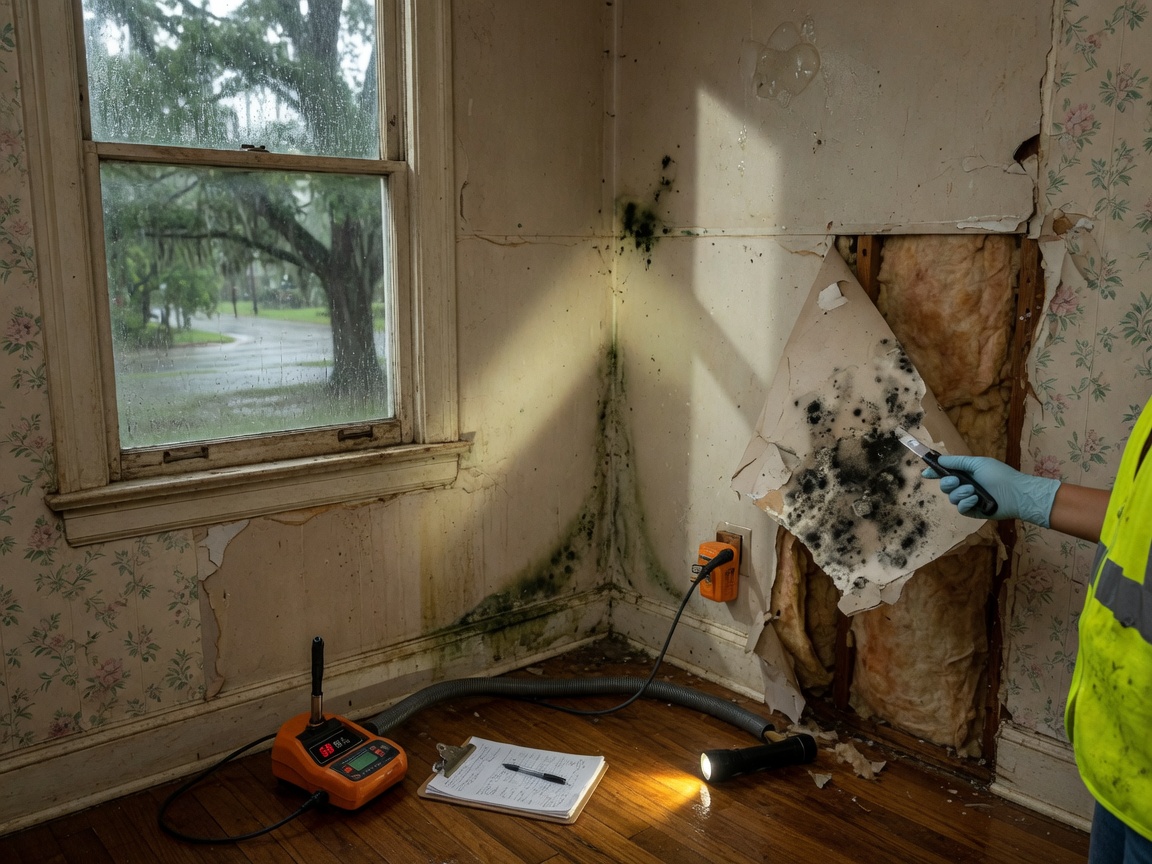
Milledgeville was Georgia's antebellum capital, and the housing stock reflects it — some of the oldest and most significant residential architecture in the state, alongside Georgia College rental property and lake houses on Sinclair. Three very different types of building, three different sets of problems.
The antebellum and Victorian housing is the most demanding work we do. These are substantial houses with plaster over wood lath, original heart pine, single-glazed sash, and foundations of brick pier or rubble construction that predate any notion of a moisture barrier. The default remediation approach — cut out two feet around the growth and replace — destroys fabric that cannot be bought back. Plaster also reads unreliably on a surface moisture meter because the lath creates air gaps, so establishing the real boundary of a colony takes a pin meter, thermal imaging or a small borescope hole. Done carefully, far less material comes out than most quotes assume.
Georgia College rentals run the university-town cycle. Units closed up and unconditioned through the summer break reach interior humidity high enough to grow mold on closet walls, bathroom ceilings and soft furnishings with no leak at all, and the calls come in August when students return. Many of these properties are also subdivided older houses where bathrooms and kitchens were added long after the building, frequently with extraction fans that terminate in the attic rather than outside — which puts a shower's worth of moisture into the roof structure twice a day, every day.
Lake Sinclair property is its own category. Seasonal occupancy means houses sit closed for months, often with the power off, and proximity to the water keeps ambient humidity high. Boat houses, docks and storage buildings are unconditioned year-round, and stored contents in them — upholstery, life jackets, leather, paper — develop growth from humidity alone. The single most effective thing a lake house owner can do is leave the air conditioning running at 78 rather than shutting it off between visits.
Milledgeville is about forty minutes east of Macon and we cover it on the same pricing, with the caveat that the historic work takes longer to investigate than standard remediation. That is deliberate. On a house of this age the investigation is what saves the plaster, and we would rather spend an extra hour with a borescope than an extra day with a saw.
Antebellum and Victorian property is covered by historic home mold remediation, beginning with mold inspection and testing so the scope stays conservative. Crawl space encapsulation handles the foundation and attic mold removal the fans and ductwork in subdivided houses. Lake property contents fall under carpet and furniture mold removal, student rentals under mold and mildew removal, and water intrusion under water damage restoration. All services; nearby Gray, Jones County and Gordon.
Around Milledgeville
We regularly work near:
- 📍Georgia College and State University
- 📍Lake Sinclair
- 📍Old Governor's Mansion
- 📍Hancock Street
- 📍Central State Hospital
- 📍Oconee River
Mold Remediation in Milledgeville — Local Notes
- •Antebellum and Victorian housing with plaster over lath, heart pine and brick pier or rubble foundations.
- •Plaster reads unreliably on surface meters, so colony boundaries need pin meters, thermal imaging or borescope checks.
- •Georgia College rentals left closed over summer break produce August mold calls with no leak involved.
- •Subdivided older houses often have bath fans terminating in the attic, wetting roof decking daily.
- •Lake Sinclair properties sit closed seasonally in high ambient humidity, with unconditioned boat houses and storage buildings.