
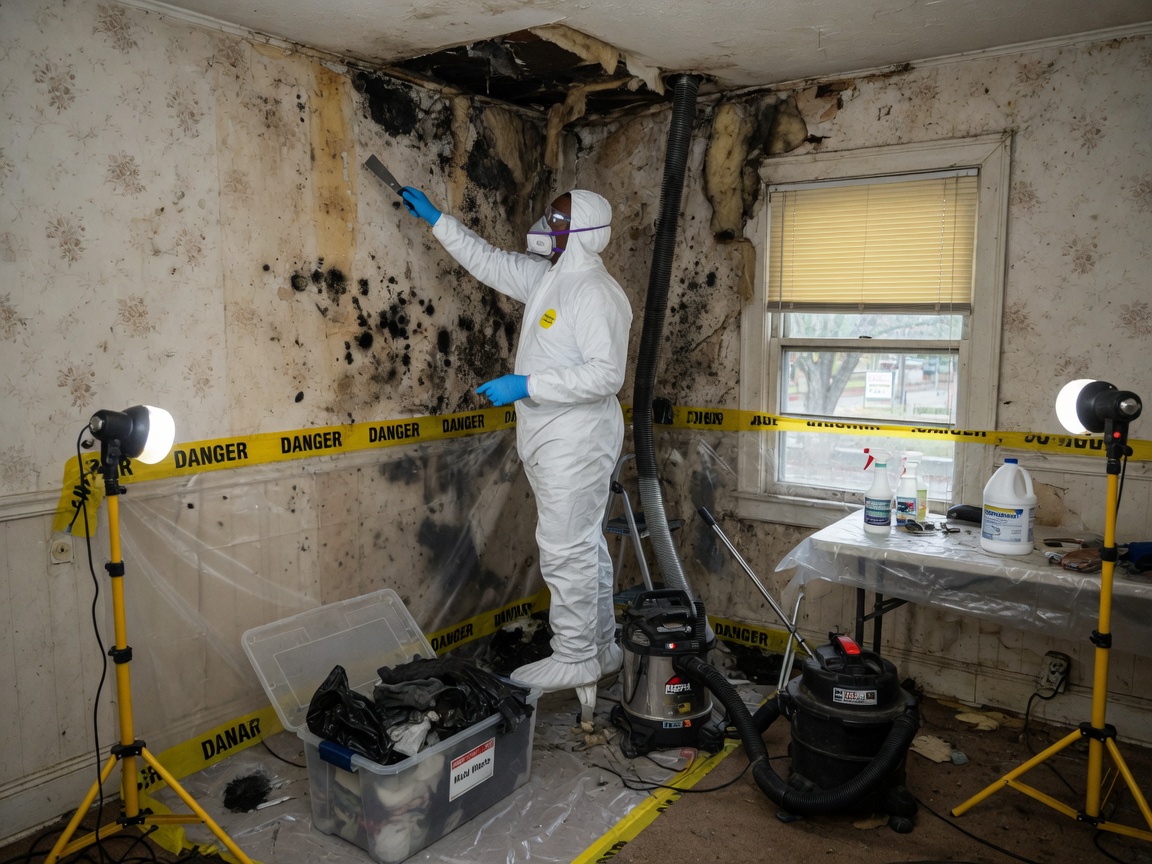
North Macon is where most of the city's post-1970 residential growth went, and the housing is predominantly newer subdivision construction — slab-on-grade and crawl space builds from the seventies onward, with substantial development along the Forsyth Road and Bass Road corridors. The mold problems here are almost entirely different from the historic districts closer to downtown.
The single most common cause we find in North Macon is air conditioning that is oversized for the house. A unit with more capacity than the load cools to the thermostat in a few minutes and shuts off, and those short run times remove very little moisture from the air. The house reads 72 degrees on the wall and sits at 60 to 65 percent relative humidity through the whole cooling season. Nothing leaks and nothing is visibly wrong, but that humidity is all mold requires, and growth appears in closets, behind furniture against exterior walls, inside cabinets on outside walls, and on bathroom ceilings.
This is counterintuitive for homeowners, who reasonably assume a cool house is a dry house. It is not. Cooling and dehumidifying are different jobs, and a system sized for the hottest afternoon of the year will under-dehumidify on every other day. The fixes are usually mechanical rather than structural: longer run times, a lower fan speed, a dehumidification mode, a whole-house dehumidifier, or right-sizing the equipment at replacement. None of that is mold work, and we will tell you so plainly.
The crawl space builds from the seventies and eighties have a second issue. Many have a thin ground cover that has been pushed aside over decades of service calls, or none at all, so bare clay is releasing moisture into the floor structure. Foundation vents were sized by a code that assumed outside air would dry the space, which in this climate frequently does the opposite — humid summer air entering a cooler crawl space condenses on joists and ductwork. Sealing the ground and controlling the space mechanically works far better here than ventilating it.
Builder-grade details account for most of the remainder: window and door flashing installed quickly, missing kick-out flashing where a roof meets a wall, tub and shower surrounds sealed with caulk rather than a proper pan, and slab vapor barriers punctured during construction. These produce slow concealed leaks that surface years later as growth inside a wall cavity with no event behind it.
Because the cause here is usually humidity, the most useful starting point is indoor air quality testing or mold inspection and testing rather than removal. Where growth has established, mold and mildew removal handles surface growth in closets and bathrooms and black mold removal the rest. Crawl space builds from the seventies and eighties benefit most from crawl space encapsulation, and ceiling growth from attic mold removal. For a burst pipe, water damage restoration. All services; nearby Shirley Hills and Bibb County.
Around North Macon
We regularly work near:
- 📍Forsyth Road
- 📍Bass Road
- 📍Zebulon Road
- 📍Wesleyan College
- 📍Rivoli Drive
- 📍Northside Drive
Mold Remediation in North Macon — Local Notes
- •Predominantly post-1970 subdivision housing, so causes are mechanical rather than age-related.
- •Oversized air conditioning short-cycles and leaves interior humidity at 60 percent or above all summer.
- •Growth concentrates where air moves least: closets, behind furniture on exterior walls, and inside cabinets.
- •Seventies and eighties crawl space builds often have a displaced thin ground cover or none at all.
- •Builder-grade flashing and shower pan details produce slow concealed leaks that surface years after construction.