
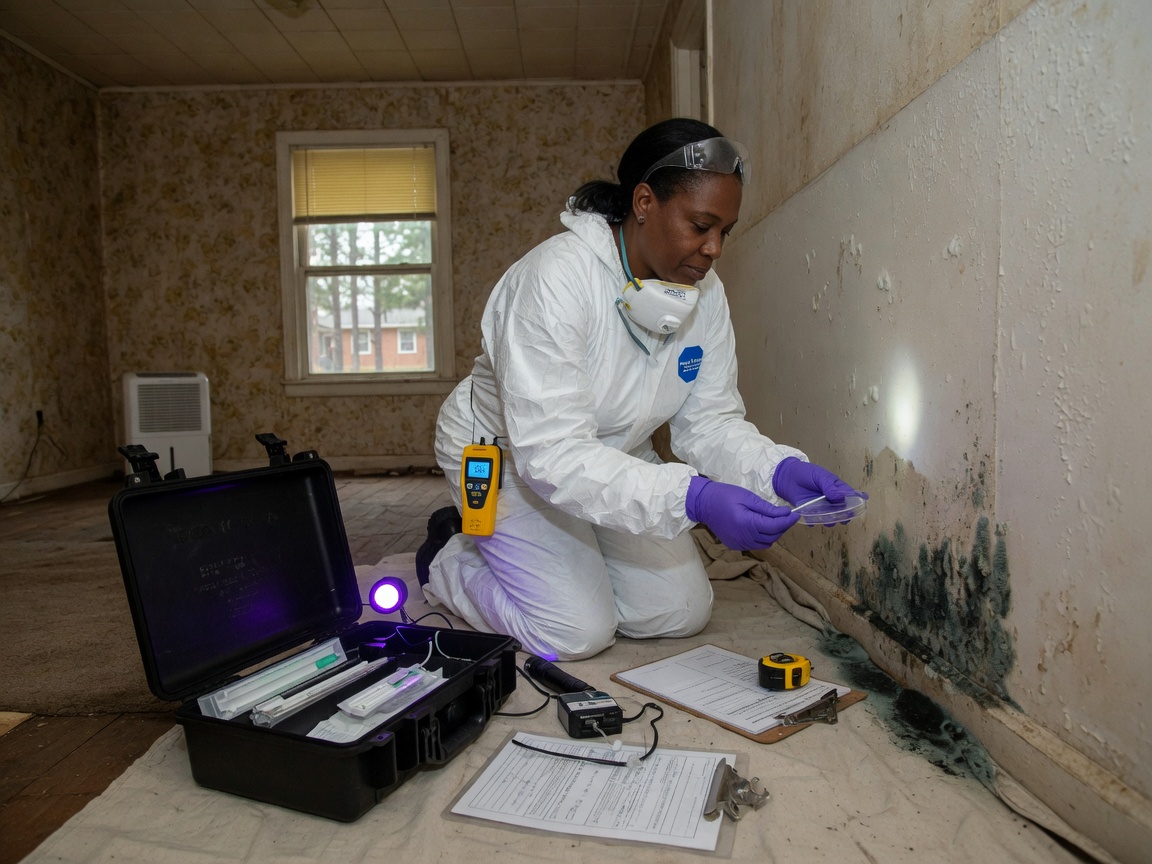
Work around Robins Air Force Base has a rhythm that civilian housing does not, and the mold problems follow it. Houses change hands on orders rather than on market timing, they sit empty between occupants for unpredictable stretches, and deadlines are external and immovable. We work to those deadlines regularly and understand that a PCS date is not a preference.
The empty-house problem is the single most common thing we are called for in this area. A property left closed with the air conditioning switched off — during a deployment, a TDY, or the gap between tenancies — reaches interior relative humidity in the seventies or higher within weeks in a Georgia summer. That is enough on its own, with no leak anywhere, for visible growth on closet walls, bathroom ceilings, leather furniture, uniforms in closets, and anything stored against an exterior wall. Families come home from a deployment to a house that was fine when they left it.
The prevention is genuinely simple and worth stating plainly: leave the thermostat running at 78 degrees rather than off. The electricity cost over three months is a small fraction of a remediation invoice, and a cheap hygrometer left somewhere a neighbour or property manager can photograph it gives you early warning. If a house must be left with the power off, sealing the crawl space and running a dehumidifier on a drain is the next best option.
Most housing in the area is post-war slab-on-grade, so the structural problems present at floor level rather than in a crawl space. Growth under vinyl plank and laminate, in carpet pad, behind baseboards, and in the bottom plate of exterior walls, usually from a slab whose under-slab vapor barrier has failed. It shows up as a musty smell with nothing visible, and it is found with a meter rather than by eye.
Documentation is where this work differs most. Property managers, landlords and housing offices want a written scope, moisture readings recorded by location, photographs, and independent clearance testing with the lab report attached — not a verbal all-clear. We produce that package as standard, and we can work to a compressed schedule for a move-out inspection or a turnover deadline. We will also tell you honestly if a deadline is not achievable rather than agreeing and running over it.
For a move-out or turnover deadline, start at emergency mold removal and mold inspection and testing, with the housing-office paperwork covered by post remediation clearance testing. Growth from an unconditioned summer is handled by mold and mildew removal and, where it has gone into the material, black mold removal. Uniforms, leather and stored gear fall under carpet and furniture mold removal, and a burst pipe under water damage restoration. All services; nearby Warner Robins, Bonaire, Kathleen and Houston County.
Around Robins Air Force Base
We regularly work near:
- 📍Robins Air Force Base
- 📍Museum of Aviation
- 📍Watson Boulevard
- 📍Russell Parkway
- 📍Highway 247
Mold Remediation in Robins Air Force Base — Local Notes
- •Mostly post-war slab-on-grade housing, so moisture presents at floor level rather than in a crawl space.
- •Deployment and TDY vacancies with the air conditioning off are the leading cause of growth in this area.
- •PCS cycles compress move-out and move-in windows, making empty-house inspection the practical option.
- •Uniforms, leather and stored goods in closets are frequently the first visible casualties of an unconditioned summer.
- •Housing offices and property managers require written clearance documentation, supplied as standard.