
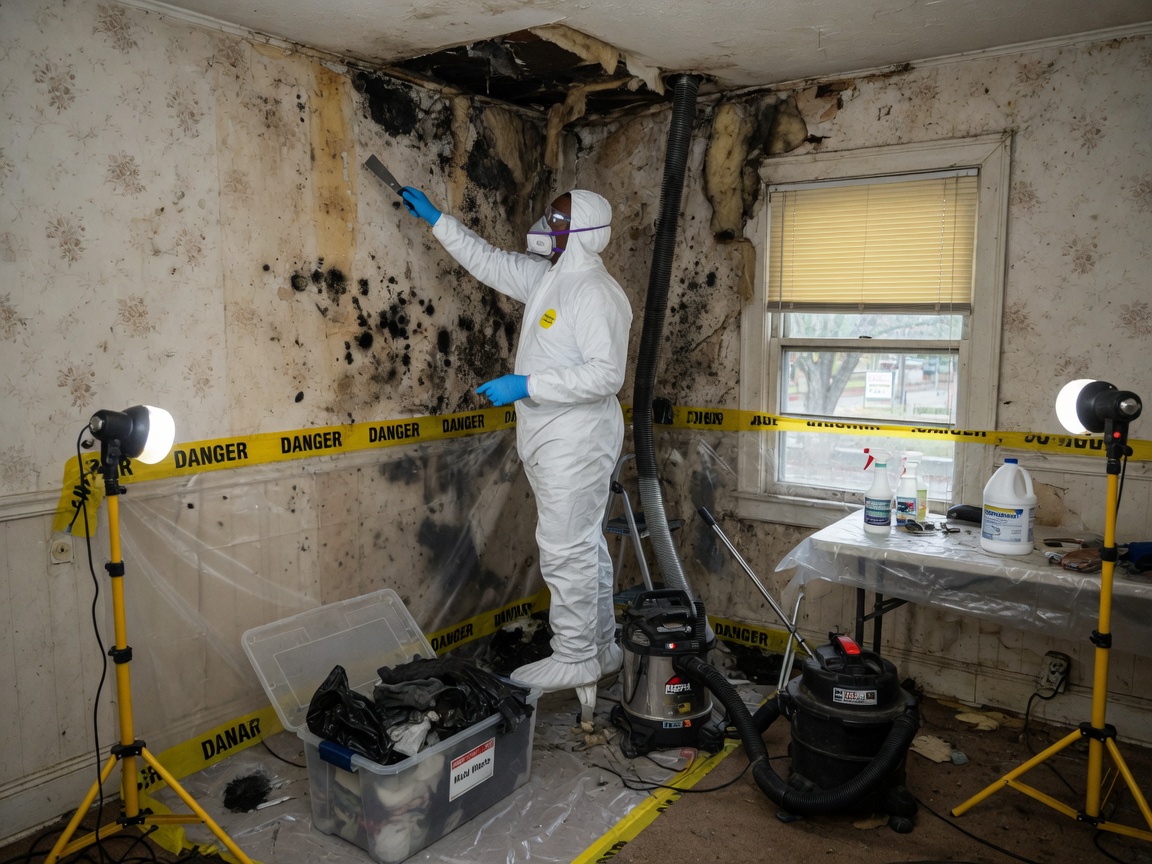
Beall's Hill sits just east of Mercer University and has been the focus of sustained revitalisation since 2007, which gives it a housing profile unlike anywhere else in Macon. Houses built between roughly 1870 and 1940 sit side by side in three very different conditions: carefully restored owner-occupied homes, rental conversions, and properties still waiting for work. The same 1890s cottage presents completely different problems depending on which of the three it is.
Fully restored houses tend to have the fewest moisture problems and the most expensive consequences when one occurs, because there is new finish work to protect. Here the job is scoping tightly — establishing the actual boundary of the growth with a pin meter or a borescope rather than opening a wall on a visual guess, so that restored plaster and millwork stay in the building.
Partially renovated properties are where most of the real problems sit, and the cause is usually a renovation that stopped halfway. A bathroom added or relocated with the extraction fan vented into the attic rather than through the roof. New drywall hung over original plaster without addressing what was behind it. A kitchen moved to an exterior wall with the plumbing run through an uninsulated cavity. These are concealed defects that surface years later, and finding them means looking at the renovation history rather than only at the symptom.
The rental conversions run the pattern common around Mercer: units closed up and unconditioned over summer break, interior humidity climbing unchecked for weeks, and growth established on closet walls and bathroom ceilings by the time tenants return in August. Several of these properties are also subdivided houses sharing a common attic or a wall cavity between units, which means containment has to account for the adjoining side — otherwise negative air pressure simply draws spores across. That is a real line item and it is the one most often missing from a cheap quote on a Beall's Hill address.
Across all three conditions the foundations are the constant. These houses sit on brick piers or early masonry over bare clay, generally with no vapor barrier, and ground moisture rising through the floor is the baseline problem underneath everything else. Sealing the crawl space is usually the highest-value item on the quote regardless of which category the house falls into.
Which service fits depends on the condition of the house. Restored properties usually need historic home mold remediation and tightly scoped black mold removal; rentals and conversions need mold inspection and testing between tenancies and commercial mold remediation where units share an attic. Crawl space encapsulation addresses the bare clay underneath every one of them, and attic mold removal covers fans vented into the roof. Independent sign-off is post remediation clearance testing. All services; nearby College Hill Corridor and Huguenin Heights.
Around Beall's Hill
We regularly work near:
- 📍Mercer University
- 📍Orange Street
- 📍Oglethorpe Street
- 📍Telfair Street
- 📍Beall's Hill Historic District
Mold Remediation in Beall's Hill — Local Notes
- •Housing from roughly 1870 to 1940 in three distinct conditions: restored, partially renovated, and awaiting work.
- •Half-finished renovations are the main source of concealed defects — relocated bathrooms, fans vented to the attic, drywall over untreated plaster.
- •Subdivided properties share attics and wall cavities, so containment must account for the adjoining unit.
- •Student rentals left closed over summer break produce August mold calls with no leak involved.
- •Brick pier and early masonry foundations over bare clay with no vapor barrier underlie everything else.