
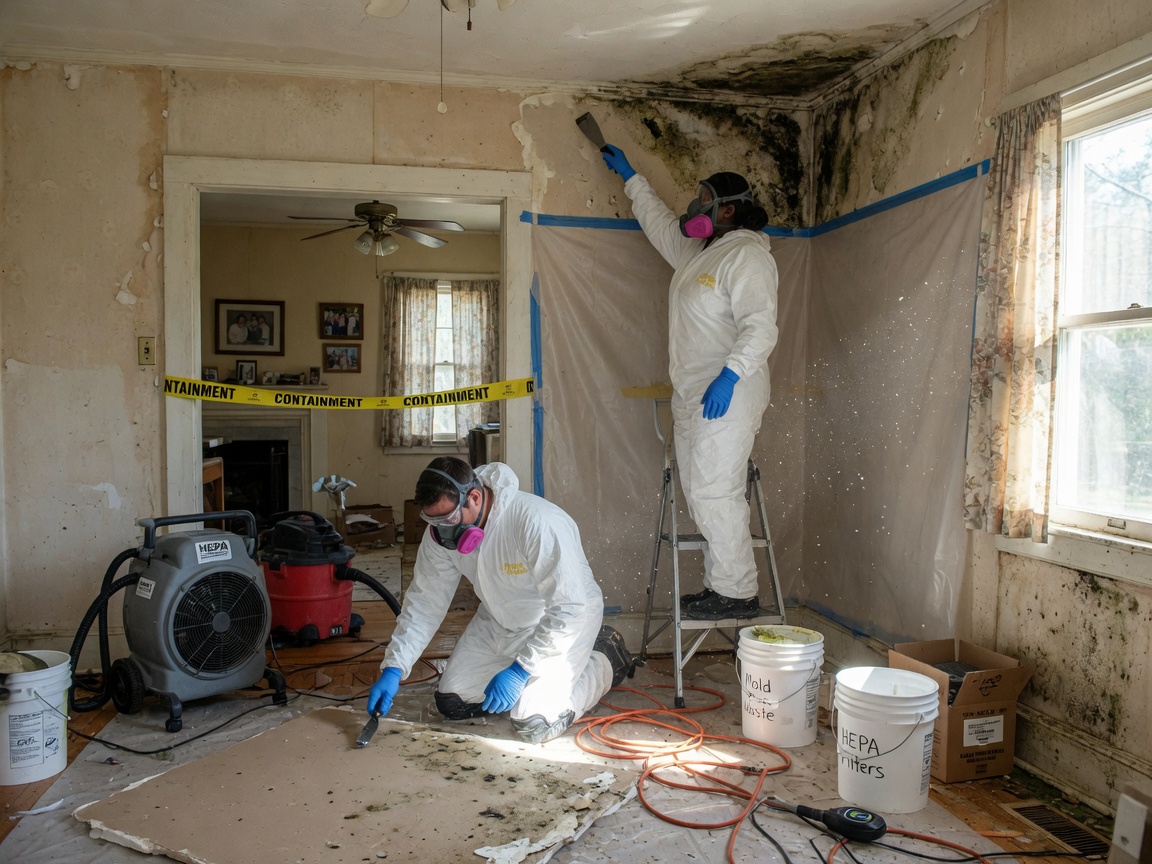
East Macon sits across the Ocmulgee from downtown and is where the city began. For mold work it is the part of Macon where flood exposure is a genuine consideration rather than a theoretical one, and that changes the whole conversation. Flood damage and a plumbing leak produce similar-looking mold and require entirely different handling.
The distinction is contamination. Floodwater has travelled across ground, through yards, past septic fields and storm drains, and it arrives carrying sewage bacteria, lawn and agricultural chemicals, fuel residue and silt. Water from a burst supply line is clean. That means the salvage rules differ completely: with floodwater, porous material that contacted it comes out regardless of how dry you can get it — carpet and pad, upholstered furniture, mattresses, particle board, wet insulation, and drywall above the waterline. Drying and keeping a soaked sofa after a flood is the wrong call every time, and the temptation to try is strong.
There is an insurance consequence worth knowing before anything happens. Standard homeowners insurance generally excludes flood, which is why flood cover exists separately through the NFIP. The same wet house can be covered or not depending on whether the water came from a pipe or from outside. We document the water line, the affected materials, moisture readings by location and the full scope photographically for exactly this reason, because that record is what a flood adjuster and a future buyer will both ask for.
Away from the floodplain, East Macon's older housing follows the regional pattern: open crawl spaces over bare clay with no vapor barrier, plaster over lath in the oldest properties, and air conditioning retrofitted through unconditioned attics. Being closer to the river keeps ambient ground moisture higher than on the ridge neighbourhoods, so crawl space sealing matters more here than in most of the city, and the crawl space is where we look first on any musty-smell call.
Sequence matters more after a flood than in any other kind of job. Remove contaminated material, clean and disinfect the structure, dry to a verified moisture target, and only then rebuild. Rebuilding over a structure still sitting at 16 percent moisture content traps the problem inside the new wall and the growth returns behind fresh drywall within a season. That drying stage is the one under the most pressure to be cut short, and it is the one we will not compromise.
If the water came from outside, the page you want is flood mold remediation, and the contents side is carpet and furniture mold removal. For a clean-water leak, water damage restoration and emergency mold removal apply instead. Away from the floodplain the usual work is crawl space encapsulation, mold inspection and testing and black mold removal, with post remediation clearance testing for independent sign-off. All services; nearby Fort Hill, Downtown Macon and Bibb County.
Around East Macon
We regularly work near:
- 📍Ocmulgee River
- 📍Ocmulgee Mounds National Historical Park
- 📍East Macon Historic District
- 📍Emery Highway
- 📍Main Street
Mold Remediation in East Macon — Local Notes
- •Proximity to the Ocmulgee floodplain makes genuine flood exposure a real consideration rather than a theoretical one.
- •Floodwater is contaminated, so salvage rules are far stricter than for a clean-water plumbing leak.
- •Standard homeowners insurance generally excludes flood, so documentation of the water source matters for the claim.
- •Higher ambient ground moisture near the river makes crawl space sealing more important here than elsewhere in the city.
- •Rebuilding before the structure reaches a verified dry target traps the problem behind new drywall.