
Monroe County sits north of Macon along the I-75 corridor, taking in Forsyth, Bolingbroke, Juliette and a large amount of rural land. It holds some of the best-preserved historic housing in central Georgia alongside newer interstate-corridor development, and the two require different approaches.
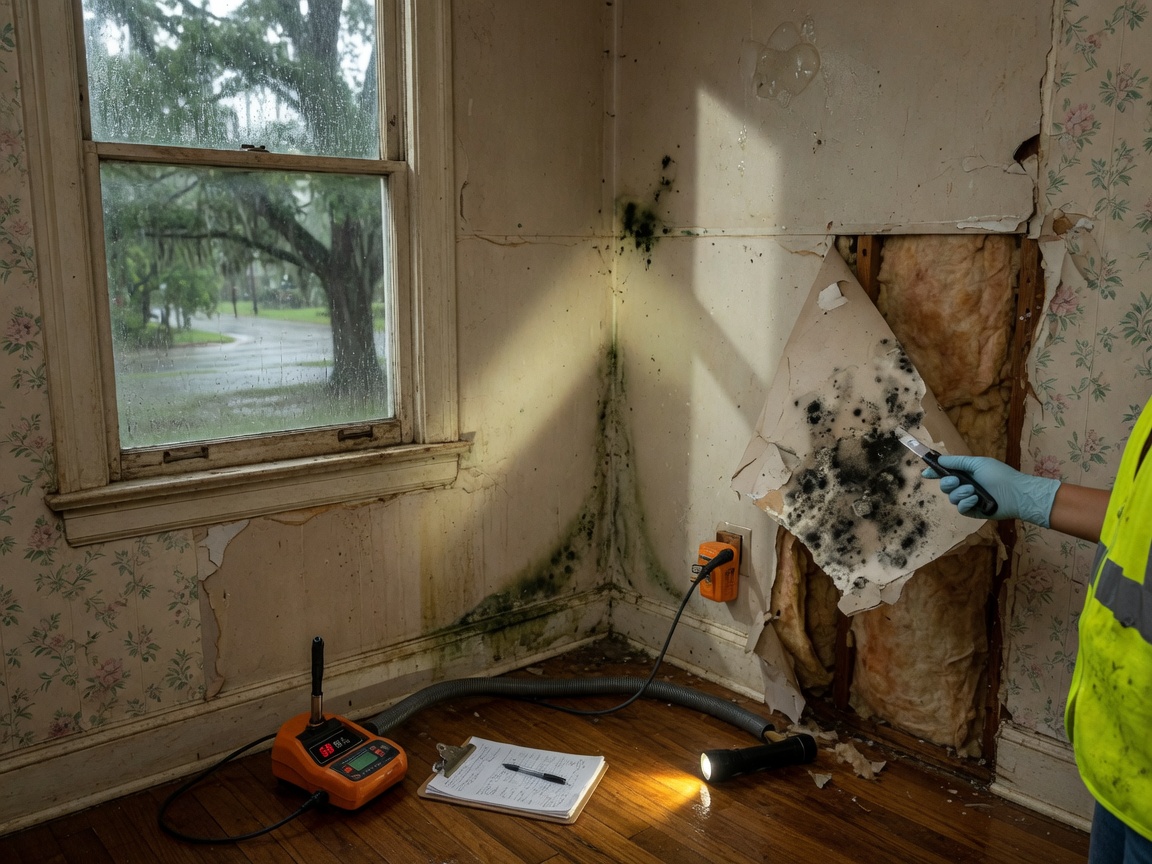
The historic housing around Forsyth's courthouse square and through the older parts of the county is the demanding work. Plaster over wood lath, original single-glazed sash windows, heart pine flooring, and foundations that predate any concept of a moisture barrier. Plaster is the technical difficulty: it holds moisture differently from drywall and reads unreliably on a surface moisture meter because the lath creates air gaps, so the visible staining rarely marks the real boundary of a colony. Finding it properly takes a pin meter, thermal imaging or a small borescope hole, and that investigation is what keeps original plaster in the building rather than in a skip.
Original windows are the recurring moisture source in this housing. Single-glazed sash with worn glazing putty and failed paint lets condensation run down and sit on the sill and apron through the whole cooling season, which keeps the wall below damp year after year. The durable answer is restoration — reglazing, repainting, repairing the sash — rather than replacement, which in a historic district may face design review in any case. We will tell you when the windows are your moisture source even though restoration is not work we sell.
Monroe County's clay drains slowly and holds storm water against foundations for days, and the mild winters never freeze-dry a crawl space, so moisture control has to operate year-round rather than seasonally. For the large proportion of county housing on open crawl spaces over bare clay, a sealed liner is the highest-value single item on the quote. Rural properties add wells, septic systems and outbuildings, with the familiar pattern of a saturated field uphill sending water toward the house.
Newer construction near the interstate runs the opposite profile — slab-on-grade, tight envelope, oversized air conditioning that cools without dehumidifying — with growth appearing in closets and at floor level rather than under the house. Because the county holds both types, diagnosis matters more than treatment method, and we would rather spend the extra hour establishing the cause than guess and have you pay for the work twice.
Historic property across this county is covered by historic home mold remediation, starting with mold inspection and testing so plaster is scoped rather than guessed. Crawl space encapsulation addresses the bare clay, attic mold removal sweating ductwork, and black mold removal the removal. Newer interstate-corridor housing is usually a humidity problem, covered by indoor air quality testing, and businesses by commercial mold remediation. Within the county we cover Forsyth, and nearby North Macon and Bibb County.
Around Monroe County
We regularly work near:
- 📍Forsyth
- 📍Bolingbroke
- 📍Juliette
- 📍Monroe County Courthouse
- 📍Interstate 75
- 📍High Falls State Park
Mold Remediation in Monroe County — Local Notes
- •Historic housing around Forsyth has plaster over lath that hides growth and reads poorly on surface moisture meters.
- •Original single-glazed sash windows are a recurring moisture source, best addressed by restoration rather than replacement.
- •Monroe County clay holds storm water against foundations for days, keeping crawl spaces damp.
- •Mild winters never freeze-dry crawl spaces, so moisture control must run year-round rather than seasonally.
- •Newer I-75 corridor construction has the opposite profile: slab, tight envelope, oversized short-cycling air conditioning.